
Eva.C
Let’s Chat
What is Heidi?
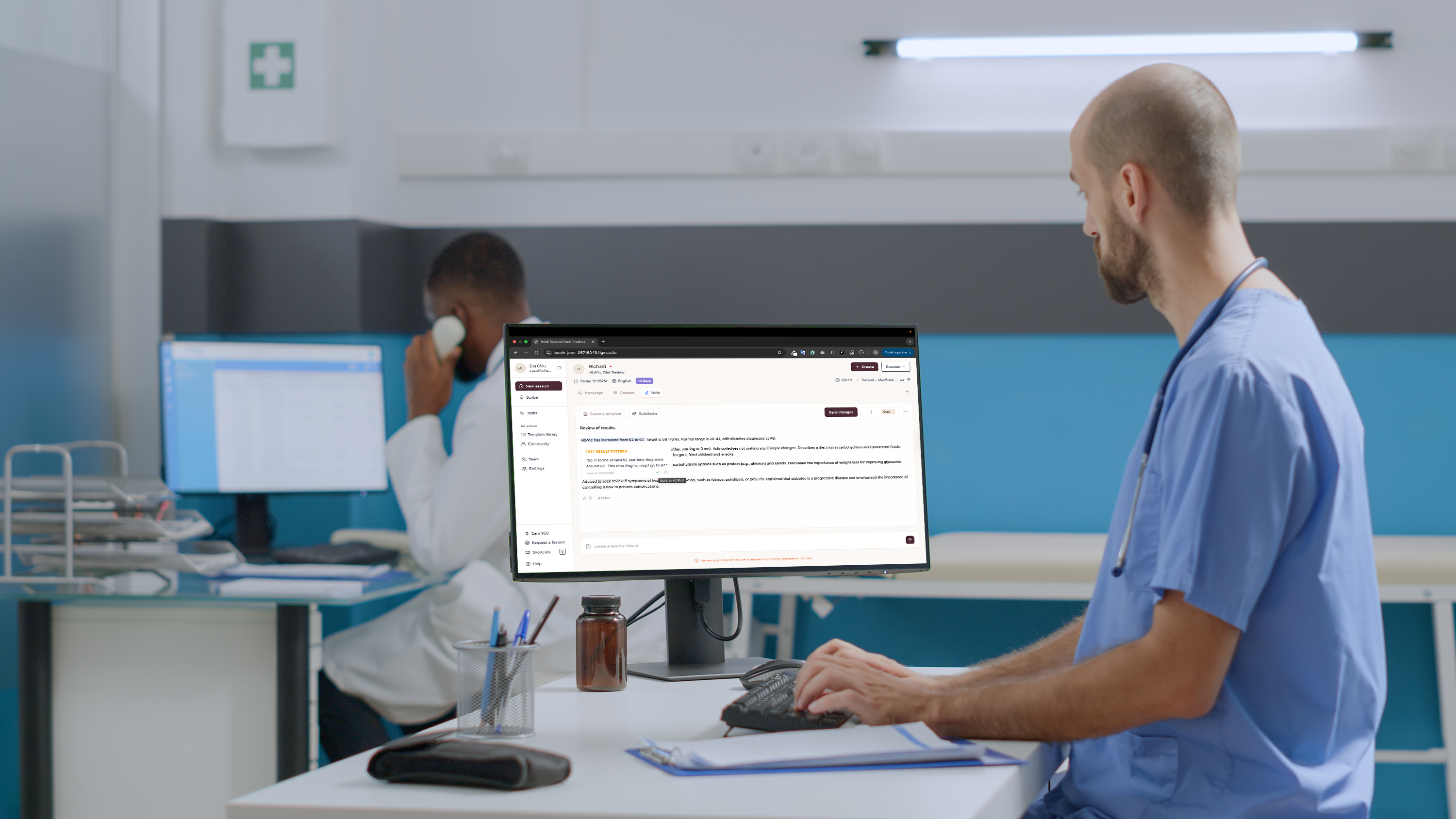
Heidi is an AI Care Partner designed to expand clinical capacity by automating administrative work – so clinicians can focus on patients.
Industries
Health Technology, Software

Location
WFH
Designed in Sydney, Australia
Team Composition
Associate Product Specialist (That’s me 👋🏻)
Project Timeframe
2 Days
Using AI In My Workflow
Opportunity &
Problem Definition


Heidi AU Roadshow 2025 |
Sydney Panel
https://youtu.be/atTzTuGTN2Y?si=FhlpyRc-jF-9J8fs

Feature Request Page
https://getheidi.canny.io/features





Meeting your professional obligations when using Artificial Intelligence in healthcare
https://www.ahpra.gov.au/Resources/Artificial-Intelligence-in-healthcare.aspx
Clinicians are experiencing significant friction when trying to synthesise a patient's medical history with a current session. Current user feedback indicates that retrieving and cross-checking data across sessions is a manual, time-consuming process.
For a tool designed to expand clinical capacity, these "micro-frictions" represent a major barrier to high-velocity documentation.

Clinicians struggle with:
- Context Fragmentation Manually "ticking" and copying previous visits into the context section for every patient to get a comprehensive summary.
- Data Attribution The inability to easily distinguish between speakers in a transcript ("Speaker 1", "Speaker 2"), which makes verifying "who said what" an arduous task.
- Verification StakesA critical need to ensure AI-supported notes are 100% accurate when the AI is summarising multiple complex data points from both historical context and live transcripts.
The product goal is to transform Heidi from a single-session scribe into a Longitudinal Care Partner.
Strategic Framework:
Data Integrity & Transparency

To solve for trust, I prioritised Data Integrity and Traceability. I developed a product framework that categorised clinical data into auditable work streams with colour codes:
Category
Result/Diagnosis
Precision & Quantitative Data
Zero tolerance for misquoted values.
Patient Behaviours
Qualitative Context
Accurate sentiment capture from the transcript.
Clinical Advice
Safety & Liability
Ensuring advice matches the clinician's spoken word.
Product Focus
Integrity Metric
Solution Design:
The "SourceCheck" Feature


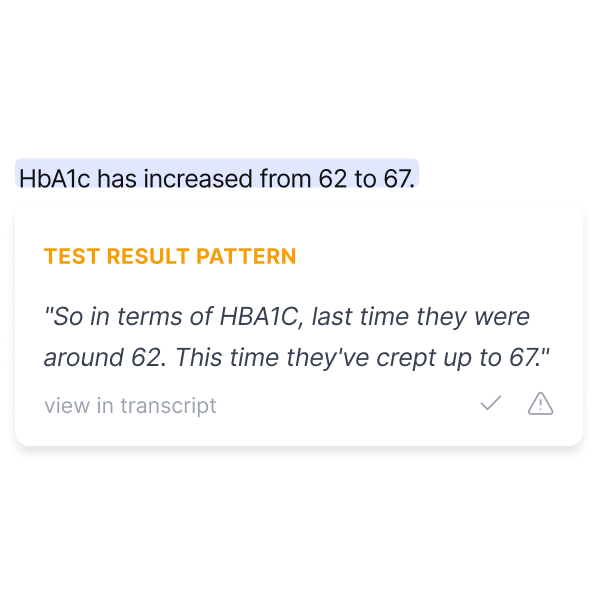
I present you the product definition for SourceCheck, a feature ecosystem designed to provide instant evidence for AI-generated session notes.
Noted: The following video is a modified interface of Heidi AI for personal design creative purpose.
Context Lens
The Interaction
Hover over a summarized note and instantly see the raw transcript source.
Click the view the transcript button to jump to full transcript through timestamp.
Validation
Human-in-the-Loop
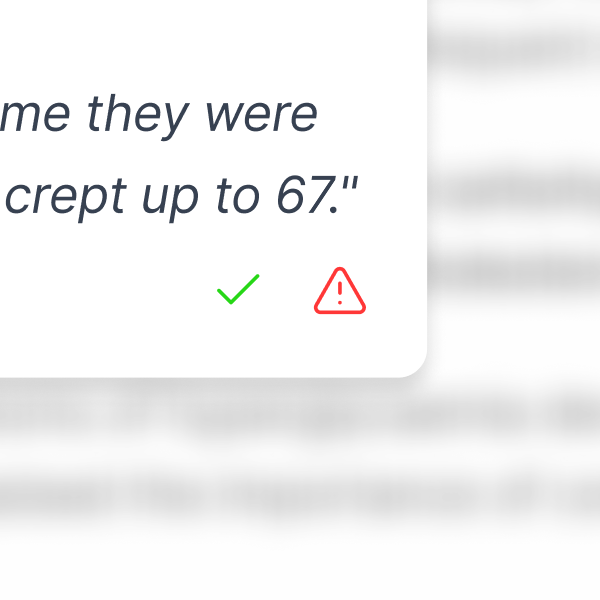
Integrated a 1-click "Verify" or "Flag" mechanism. This creates a high-quality feedback loop that improves Heidi’s underlying LLM performance over time.

Return to Note

Context Lens
Workflow Continuity
Designed a seamless "Jump & Return" navigation loop to allow for deep-context auditing without losing progress in the documentation workspace.
Designed around real-world clinician feedback, SourceCheck transforms clinicians from manual authors into strategic auditors, ensuring every note is a traceable and verifiable medical record so they can reclaim their time for deeply human patient care.
Next Steps
Validate ConceptCreate a clickable-prototype under clinician’s supervision. The synthesised note used in the prototype should include at least one clinical data that falls into each auditable work stream, i.e. Result/Diagnosis, Patient Behaviour, and Clinical Advice. During A/B testing, observe practitioners’ eye movement and operation speed for quantitive data.
Interview afterwards to confirm:1. accountability - does the clinician feel they have enough "human oversight" to safely sign off on the record?2. traceability - does the hover-state and the view the transcript button provide enough information about the "derivation" of the note?3. accuracy - have the clinician "flag" an intentionally misplaced source to see if the feedback loop for correcting AI errors is intuitive?
Data MappingCollaborate with engineers to define requirements for "Keyword-to-Timestamp" mapping accuracy and determine if the underlying LLM can categorise three auditable work streams
Ensure Design ConsistencyMaintain a "Low Cognitive Load" interface to ensure the feature didn't interfere with the 2 million consults Heidi supports weekly.
Stay CompliantDesign with an emphasis on the "Source of Truth" (the transcript), critical for healthcare environments across 116 countries.
Eva Chiu
Let’s Chat
What is Heidi?
Heidi is an AI Care Partner designed to expand clinical capacity by automating administrative work – so clinicians can focus on patients.
Industries
Health Technology, Software

Location
WFH
Designed in Sydney, Australia
Team Composition
Associate Product Specialist (That’s me 👋🏻)
Project Timeframe
2 Days
Using AI In My Workflow
Opportunity &
Problem Definition

Heidi AU Roadshow 2025 |
Sydney Panel
https://youtu.be/atTzTuGTN2Y?si=FhlpyRc-jF-9J8fs
Feature Request Page
https://getheidi.canny.io/features
Meeting your professional obligations when using Artificial Intelligence in healthcare
https://www.ahpra.gov.au/Resources/Artificial-Intelligence-in-healthcare.aspx
Clinicians are experiencing significant friction when trying to synthesise a patient's medical history with a current session. Current user feedback indicates that retrieving and cross-checking data across sessions is a manual, time-consuming process.
For a tool designed to expand clinical capacity, these "micro-frictions" represent a major barrier to high-velocity documentation.
Clinicians struggle with:
- Context Fragmentation Manually "ticking" and copying previous visits into the context section for every patient to get a comprehensive summary.
- Data Attribution The inability to easily distinguish between speakers in a transcript ("Speaker 1", "Speaker 2"), which makes verifying "who said what" an arduous task.
- Verification StakesA critical need to ensure AI-supported notes are 100% accurate when the AI is summarising multiple complex data points from both historical context and live transcripts.
The product goal is to transform Heidi from a single-session scribe into a Longitudinal Care Partner.
Strategic Framework:
Data Integrity & Transparency


To solve for trust, I prioritised Data Integrity and Traceability. I developed a product framework that categorised clinical data into auditable work streams with colour codes:
Category
Result/Diagnosis
Precision & Quantitative Data
Zero tolerance for misquoted values.
Patient Behaviours
Qualitative Context
Accurate sentiment capture from the transcript.
Clinical Advice
Safety & Liability
Ensuring advice matches the clinician's spoken word.
Product Focus
Integrity Metric
Solution Design:
The "SourceCheck" Feature

I present you the product definition for SourceCheck, a feature ecosystem designed to provide instant evidence for AI-generated session notes.
Noted: The following video is a modified interface of Heidi AI for personal design creative purpose.
Context Lens
The Interaction
Hover over a summarized note and instantly see the raw transcript source.
Click the view the transcript button to jump to full transcript through timestamp.
Validation
Human-in-the-Loop
Integrated a 1-click "Verify" or "Flag" mechanism. This creates a high-quality feedback loop that improves Heidi’s underlying LLM performance over time.
Return to Note
Context Lens
Workflow Continuity
Designed a seamless "Jump & Return" navigation loop to allow for deep-context auditing without losing progress in the documentation workspace.
Designed around real-world clinician feedback, SourceCheck transforms clinicians from manual authors into strategic auditors, ensuring every note is a traceable and verifiable medical record so they can reclaim their time for deeply human patient care.
Next Steps
Validate ConceptCreate a clickable-prototype under clinician’s supervision. The synthesised note used in the prototype should include at least one clinical data that falls into each auditable work stream, i.e. Result/Diagnosis, Patient Behaviour, and Clinical Advice. During A/B testing, observe practitioners’ eye movement and operation speed for quantitive data.
Interview afterwards to confirm:1. accountability - does the clinician feel they have enough "human oversight" to safely sign off on the record?2. traceability - does the hover-state and the view the transcript button provide enough information about the "derivation" of the note?3. accuracy - have the clinician "flag" an intentionally misplaced source to see if the feedback loop for correcting AI errors is intuitive?
Data MappingCollaborate with engineers to define requirements for "Keyword-to-Timestamp" mapping accuracy and determine if the underlying LLM can categorise three auditable work streams
Ensure Design ConsistencyMaintain a "Low Cognitive Load" interface to ensure the feature didn't interfere with the 2 million consults Heidi supports weekly.
Stay CompliantDesign with an emphasis on the "Source of Truth" (the transcript), critical for healthcare environments across 116 countries.
Eva Chiu
Let’s Chat
Heidi is an AI Care Partner designed to expand clinical capacity by automating administrative work – so clinicians can focus on patients.
What is Heidi?
Industries
Health Technology, Software

Location
WFH
Designed in Sydney, Australia
Team Composition
Associate Product Specialist (That’s me 👋🏻)
Project Timeframe
2 Days
Using AI In My Workflow
Opportunity & Problem Definition
Heidi AU Roadshow 2025 |
Sydney Panel
https://youtu.be/atTzTuGTN2Y?si=FhlpyRc-jF-9J8fs
Feature Request Page
https://getheidi.canny.io/features
Meeting your professional obligations when using Artificial Intelligence in healthcare
https://www.ahpra.gov.au/Resources/Artificial-Intelligence-in-healthcare.aspx
Clinicians are experiencing significant friction when trying to synthesise a patient's medical history with a current session. Current user feedback indicates that retrieving and cross-checking data across sessions is a manual, time-consuming process.
For a tool designed to expand clinical capacity, these "micro-frictions" represent a major barrier to high-velocity documentation.
Clinicians struggle with:
- Context Fragmentation Manually "ticking" and copying previous visits into the context section for every patient to get a comprehensive summary.
- Data Attribution The inability to easily distinguish between speakers in a transcript ("Speaker 1", "Speaker 2"), which makes verifying "who said what" an arduous task.
- Verification StakesA critical need to ensure AI-supported notes are 100% accurate when the AI is summarising multiple complex data points from both historical context and live transcripts.
The product goal is to transform Heidi from a single-session scribe into a Longitudinal Care Partner.
Strategic Framework:
Data Integrity & Transparency
To solve for trust, I prioritised Data Integrity and Traceability. I developed a product framework that categorised clinical data into auditable work streams with colour codes:
Category
Result/Diagnosis
Precision & Quantitative Data
Zero tolerance for misquoted values.
Patient Behaviours
Qualitative Context
Accurate sentiment capture from the transcript.
Clinical Advice
Safety & Liability
Ensuring advice matches the clinician's spoken word.
Product Focus
Integrity Metric
Solution Design:
The "SourceCheck" Feature
I present you the product definition for SourceCheck, a feature ecosystem designed to provide instant evidence for AI-generated session notes.
Noted: The following video is a modified interface of Heidi AI for personal design creative purpose.
Context Lens
The Interaction
Hover over a summarised note and instantly see the raw transcript source.
Click the “view the transcript” button to jump to full transcript through timestamp.
Validation
Human-in-the-Loop
Integrated a 1-click "Verify" or "Flag" mechanism. This creates a high-quality feedback loop that improves Heidi’s underlying LLM performance over time.
Return to Note
Navigation
Workflow Continuity
Designed a seamless "Jump & Return" navigation loop to allow for deep-context auditing without losing progress in the documentation workspace.
Designed around real-world clinician feedback, SourceCheck transforms clinicians from manual authors into strategic auditors, ensuring every note is a traceable and verifiable medical record so they can reclaim their time for deeply human patient care.
Next Steps
Validate ConceptCreate a clickable-prototype under clinician’s supervision. The synthesised note used in the prototype should include at least one clinical data that falls into each auditable work stream, i.e. Result/Diagnosis, Patient Behaviour, and Clinical Advice. During A/B testing, observe practitioners’ eye movement and operation speed for quantitive data.
Interview afterwards to confirm:1. accountability - does the clinician feel they have enough "human oversight" to safely sign off on the record?2. traceability - does the hover-state and the view the transcript button provide enough information about the "derivation" of the note?3. accuracy - have the clinician "flag" an intentionally misplaced source to see if the feedback loop for correcting AI errors is intuitive?
Data MappingCollaborate with engineers to determine if the underlying LLM has enough clinical terminologies to categorise three auditable work streams and define requirements for "Keyword-to-Timestamp" mapping accuracy.
Ensure Design ConsistencyMaintain a "Low Cognitive Load" interface to ensure the feature didn't interfere with the 2 million consults Heidi supports weekly.
Stay CompliantDesign with an emphasis on the "Source of Truth" (the transcript), critical for healthcare environments across 116 countries.
Eva Chiu
Let’s Chat
Heidi is an AI Care Partner designed to expand clinical capacity by automating administrative work – so clinicians can focus on patients.
What is Heidi?
Industries
Health Technology, Software

Location
WFH
Designed in Sydney, Australia
Team Composition
Associate Product Specialist (That’s me 👋🏻)
Project Timeframe
2 Days
Using AI In My Workflow
Opportunity & Problem Definition
Heidi AU Roadshow 2025 |
Sydney Panel
https://youtu.be/atTzTuGTN2Y?si=FhlpyRc-jF-9J8fs
Feature Request Page
https://getheidi.canny.io/features
Meeting your professional obligations when using Artificial Intelligence in healthcare
https://www.ahpra.gov.au/Resources/Artificial-Intelligence-in-healthcare.aspx
Clinicians are experiencing significant friction when trying to synthesise a patient's medical history with a current session. Current user feedback indicates that retrieving and cross-checking data across sessions is a manual, time-consuming process.
For a tool designed to expand clinical capacity, these "micro-frictions" represent a major barrier to high-velocity documentation.
Clinicians struggle with:
- Context Fragmentation Manually "ticking" and copying previous visits into the context section for every patient to get a comprehensive summary.
- Data Attribution The inability to easily distinguish between speakers in a transcript ("Speaker 1", "Speaker 2"), which makes verifying "who said what" an arduous task.
- Verification StakesA critical need to ensure AI-supported notes are 100% accurate when the AI is summarising multiple complex data points from both historical context and live transcripts.
The product goal is to transform Heidi from a single-session scribe into a Longitudinal Care Partner.
Strategic Framework:
Data Integrity & Transparency
To solve for trust, I prioritised Data Integrity and Traceability. I developed a product framework that categorised clinical data into auditable work streams with colour codes:
Category
Result/Diagnosis
Precision & Quantitative Data
Zero tolerance for misquoted values.
Patient Behaviours
Qualitative Context
Accurate sentiment capture from the transcript.
Clinical Advice
Safety & Liability
Ensuring advice matches the clinician's spoken word.
Product Focus
Integrity Metric
Solution Design:
The "SourceCheck" Feature
I present you the product definition for SourceCheck, a feature ecosystem designed to provide instant evidence for AI-generated session notes.
Noted: The following video is a modified interface of Heidi AI for personal design creative purpose.
Context Lens
The Interaction
Hover over a summarized note and instantly see the raw transcript source.
Click the view the transcript button to jump to full transcript through timestamp.
Validation
Human-in-the-Loop
Integrated a 1-click "Verify" or "Flag" mechanism. This creates a high-quality feedback loop that improves Heidi’s underlying LLM performance over time.
Return to Note
Context Lens
Workflow Continuity
Designed a seamless "Jump & Return" navigation loop to allow for deep-context auditing without losing progress in the documentation workspace.
Designed around real-world clinician feedback, SourceCheck transforms clinicians from manual authors into strategic auditors, ensuring every note is a traceable and verifiable medical record so they can reclaim their time for deeply human patient care.
Next Steps
Validate ConceptCreate a clickable-prototype under clinician’s supervision. The synthesised note used in the prototype should include at least one clinical data that falls into each auditable work stream, i.e. Result/Diagnosis, Patient Behaviour, and Clinical Advice. During A/B testing, observe practitioners’ eye movement and operation speed for quantitive data.
Interview afterwards to confirm:1. accountability - does the clinician feel they have enough "human oversight" to safely sign off on the record?2. traceability - does the hover-state and the view the transcript button provide enough information about the "derivation" of the note?3. accuracy - have the clinician "flag" an intentionally misplaced source to see if the feedback loop for correcting AI errors is intuitive?
Data MappingCollaborate with engineers to define requirements for "Keyword-to-Timestamp" mapping accuracy and determine if the underlying LLM can categorise three auditable work streams
Ensure Design ConsistencyMaintain a "Low Cognitive Load" interface to ensure the feature didn't interfere with the 2 million consults Heidi supports weekly.
Stay CompliantDesign with an emphasis on the "Source of Truth" (the transcript), critical for healthcare environments across 116 countries.