
Eva.C
Let’s Chat
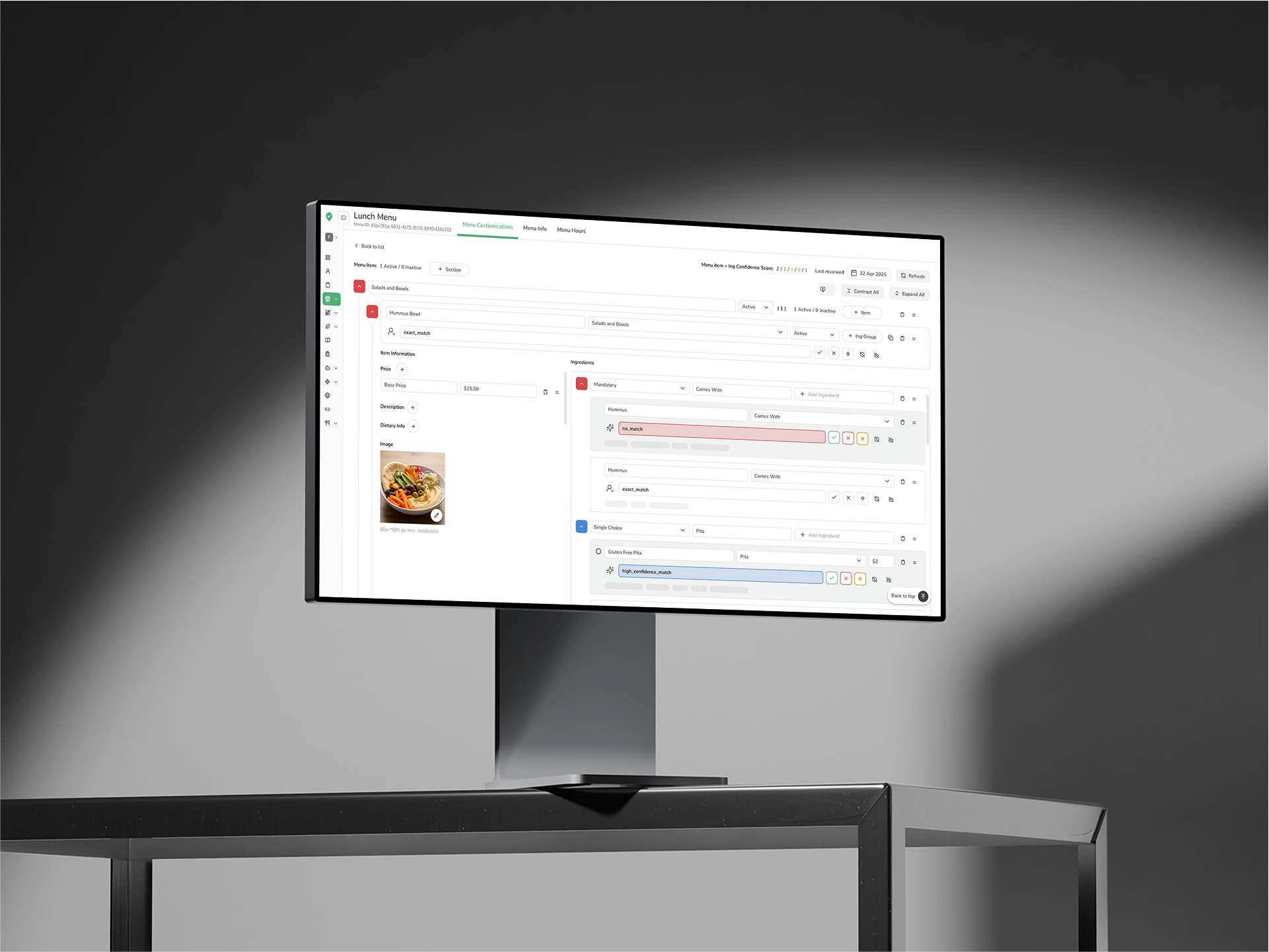
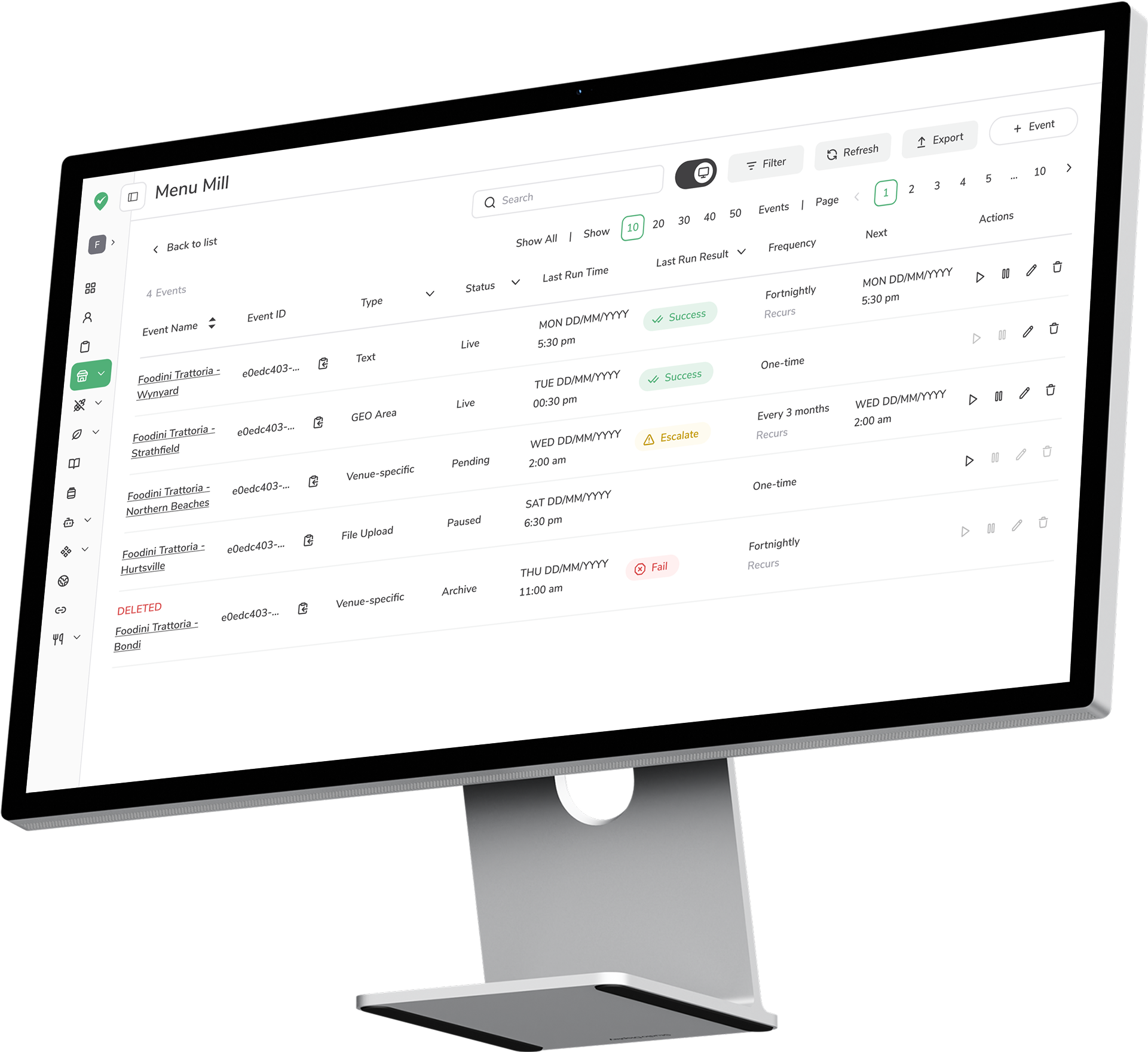
The Dietitian Portal is where Foodini's substantial ingredient data work its magic, combining the power of AI with the expertise of human dietitian.


Industries
Technology, Hospitality, Lifestyle

Location
Sydney, Australia
Team Composition
Chief Operation Officer,
Head of Dietitian,
Head of Technology,
1 Senior Backend Engineer,
1 UI/UX Designer(That’s me 👋🏻)
Project Timeframe
5 Months
Design System
Designed from scratch
Impact
7
Foodini Dietitians using daily
Serves as the daily operational hub and the single source of truth, allowing them to maintain data integrity with minimal friction.
87%
Increase in Menu Onboarding Efficiency
Free up dietitians from repetitive restaurant and menu data entry, increasing information accuracy and up-to-date.
12k+
Ingredient Data Hosted
With clear diet, allergen, ingredient, product, recipe information heirachy
Timeline
2025
Jan

Feb
March
April
May
June
Research
UI/UX Designer
Design System
UI/UX Designer
Wireframes & Iterations
UI/UX Designer
Hi-Fi Designs
UI/UX Designer
Development
CTO & Senior Backend Engineer
Testing
Whole team
Context
The world of food is more competitive than ever with diverse menus and specialty recipes, managing all that ingredient data is a huge hassle. Menu and recipe data comes in all kinds of forms, for the Foodini dietitian, onboarding even a simple restaurant could take at least two days of painstaking manual work. In order to scale the restaurant partner reach, the new portal has to be capable of operational efficiency and reliability with AI.
Key Challenges
- Dietitian didn’t know where to start - there are 12k+ data and is still growing!
- Fitting into the dietitian team ecosystem
- Data storage and information architecture for global scalability
User Needs (Dietitian)
- Easily spot which area requires human verification or decision
- Clean and minimal interfaces that take low cognitive loads to manage menus
- Clear navigation to reach the data or pages they are looking for
Project Vision
The goal is to establish a user-friendly environment where artificial intelligence efficiently analyzes the menu and ingredient information. In this setting, the dietitian plays a crucial role, taking charge of training the AI and validating its outputs to ensure accuracy and reliability, thereby providing essential support throughout the process.
Workshops
Colours of AI confidence score
Accredited practising dietitian as target users
Hi-fi designs produced
Solution 1
Colour-code AI Confidence Score
I designed a colour system that reflects the AI certainty on menu data matching. This allowed the dietitians to quickly identify areas required their inputs, transitioning them from "manual data entry authors" to "strategic auditors."
The colours are chosen based on colour theory. For example, red is psychologically powerful, commonly used to create an alert to grab attention, which is used as the no match UI visual. Green is usually used as “safety and permission”, however it is not selected into the scoring system because there are already four highlight colours in the interface. To reduce cognitive load, white is used to represent exact match.
Category
10_Exact Match
#FFFFFFF
AI has 90%+ certainty.
Dietitians can browse through.
20_High Confidence
#4887D8
AI has 75% certainty.
Dietitians perform a "Spot Check".
30_Medium Confidence
#D89648
AI has 25% certainty.
Dietitians must "Manually Intervene".
UI Visual
Logic & Human Action
40_Low Confidence
50_No Match
#D8C948
#D84848
AI found a partial match or ambiguous phrasing.
Dietitians are required to "Review & Confirm."
AI cannot find a safe match or data is missing. User must "Manually Intervene" and "Train the Model.
Solution 2
Training & Feedback Loop
A set of five action buttons are used to validate, modify, escalate, reclassify, or unlink AI matches to Foodini ingredient data. Every time a dietitian corrected a match, the action feeds data back into the AI model for training purposes and improving future accuracy.

Validates the match and allows the AI continue using this data.

Triggers a pop-up to type in reason for correction and search bar to modify match.

Escalate the issue to the Head of Dietitian for executive decision.

Reclassify/reload the match result when there is a bug/not showing matches.

Authorised to Head of Dietitian only. Used when matches are incorrect in several areas.

Result
The onboarding time significantly reduced from 2 days to 4 hours per restaurant menu, representing an 87.5% boost in productivity.
The new portal empowers Foodini dietitians to seamlessly blend their expertise with AI, ensuring rapid, accurate menu data processing and classification, which directly facilitate the company’s scaling objectives.

Future Step
The US regulation on food preparation and ingredient label varies from Australia, which the dietitian portal requires additional UI to cope with extra nutritional data management.
Eva Chiu
Let’s Chat
The Dietitian Portal is where Foodini's substantial ingredient data work its magic, combining the power of AI with the expertise of human dietitian.
Industries
Technology, Hospitality, Lifestyle

Location
Sydney, Australia
Team Composition
Chief Operation Officer,
Head of Dietitian,
Head of Technology,
1 Senior Backend Engineer,
1 UI/UX Designer(That’s me 👋🏻)
Project Timeframe
5 Months
Design System
Designed from scratch
Impact
7
Foodini Dietitians using daily
Serves as the daily operational hub and the single source of truth, allowing them to maintain data integrity with minimal friction.
87%
Increase in Menu Onboarding Efficiency
Free up dietitians from repetitive restaurant and menu data entry, increasing information accuracy and up-to-date.
12k+
Ingredient Data Hosted
With clear diet, allergen, ingredient, product, recipe information heirachy
Timeline
2025
Jan

Feb
March
April
May
June
Research
UI/UX Designer
Design System
UI/UX Designer
Wireframes & Iterations
UI/UX Designer
Hi-Fi Designs
UI/UX Designer
Development
CTO & Senior Backend Engineer
Testing
Whole team
Context
The world of food is more competitive than ever with diverse menus and specialty recipes, managing all that ingredient data is a huge hassle. Menu and recipe data comes in all kinds of forms, for the Foodini dietitian, onboarding even a simple restaurant could take at least two days of painstaking manual work. In order to scale the restaurant partner reach, the new portal has to be capable of operational efficiency and reliability with AI.
Key Challenges
- Dietitian didn’t know where to start - there are 12k+ data and is still growing!
- Fitting into the dietitian team ecosystem
- Data storage and information architecture for global scalability
User Needs (Dietitian)
- Easily spot which area requires human verification or decision
- Clean and minimal interfaces that take low cognitive loads to manage menus
- Clear navigation to reach the data or pages they are looking for
Project Vision
The goal is to establish a user-friendly environment where artificial intelligence efficiently analyzes the menu and ingredient information. In this setting, the dietitian plays a crucial role, taking charge of training the AI and validating its outputs to ensure accuracy and reliability, thereby providing essential support throughout the process.
Workshops
Colours of AI confidence score
Accredited practising dietitian as target users
Hi-fi designs produced
Solution 1
Colour-code AI Confidence Score
I designed a colour system that reflects the AI certainty on menu data matching. This allowed the dietitians to quickly identify areas required their inputs, transitioning them from "manual data entry authors" to "strategic auditors."
The colours are chosen based on colour theory. For example, red is psychologically powerful, commonly used to create an alert to grab attention, which is used as the no match UI visual. Green is usually used as “safety and permission”, however it is not selected into the scoring system because there are already four highlight colours in the interface. To reduce cognitive load, white is used to represent exact match.
Category
10_Exact Match
#FFFFFFF
AI has 90%+ certainty.
Dietitians can browse through.
20_High Confidence
#4887D8
AI has 75% certainty.
Dietitians perform a "Spot Check".
30_Medium Confidence
#D89648
AI has 25% certainty.
Dietitians must "Manually Intervene".
UI Visual
Logic & Human Action
40_Low Confidence
50_No Match
#D8C948
#D84848
AI found a partial match or ambiguous phrasing.
Dietitians are required to "Review & Confirm."
AI cannot find a safe match or data is missing. User must "Manually Intervene" and "Train the Model.
Solution 2
Training & Feedback Loop
A set of five action buttons are used to validate, modify, escalate, reclassify, or unlink AI matches to Foodini ingredient data. Every time a dietitian corrected a match, the action feeds data back into the AI model for training purposes and improving future accuracy.

Validates the match and allows the AI continue using this data.

Triggers a pop-up to type in reason for correction and search bar to select best match.

Escalate the issue to the Head of Dietitian for executive decision.

Reclassify/reload the match result when there is a bug/not showing matches.

Authorised to Head of Dietitian only. Used when matches are incorrect in several areas.
Result
The onboarding time significantly reduced from 2 days to 4 hours per restaurant menu, representing an 87.5% boost in productivity.
The new portal empowers Foodini dietitians to seamlessly blend their expertise with AI, ensuring rapid, accurate menu data processing and classification, which directly facilitate the company’s scaling objectives.
Future Step
The US regulation on food preparation and ingredient label varies from Australia, which the dietitian portal requires additional UI to cope with extra nutritional data management.
Eva Chiu
Let’s Chat
The Dietitian Portal is where Foodini's substantial ingredient data work its magic, combining the power of AI with the expertise of human dietitian.
Industries
Technology, Hospitality, Lifestyle

Location
Sydney, Australia
Team Composition
Chief Operation Officer,
Head of Dietitian,
Head of Technology,
1 Senior Backend Engineer,
1 UI/UX Designer(That’s me 👋🏻)
Project Timeframe
5 Months
Design System
Designed from scratch
Impact
7
Foodini Dietitians using daily
Serves as the daily operational hub and the single source of truth, allowing them to maintain data integrity with minimal friction.
87%
Increase in Menu Onboarding Efficiency
Free up dietitian from repetitive restaurant and menu data entry with AI, ensuring information is accurate and up-to-date.
12k+
Ingredient Data Hosted
With clear diet, allergen, ingredient, product, recipe information hierarchy and data management.
Timeline
2025
Jan

Feb
March
April
May
June
Research
UI/UX Designer
Design System
UI/UX Designer
Wireframes & Iterations
UI/UX Designer
Hi-Fi Designs
UI/UX Designer
Development
CTO & Senior Backend Engineer
Testing
Whole team
Context
The world of food is more competitive than ever with diverse menus and specialty recipes, managing all that ingredient data is a huge hassle. Menu and recipe data comes in all kinds of forms, for the Foodini dietitian, onboarding even a simple restaurant could take at least two days of painstaking manual work. In order to scale the restaurant partner reach, the new portal has to be capable of operational efficiency and reliability with AI.
Key Challenges
- Dietitian didn’t know where to start - there are 12k+ data and is still growing!
- Fitting into the dietitian team ecosystem
- Data storage and information architecture for global scalability
User Needs (Dietitian)
- Easily spot which area requires human verification or decision
- Clean and minimal interfaces that take low cognitive loads to manage menus
- Clear navigation to reach the data or pages they are looking for
Project Vision
The goal is to establish a user-friendly environment where AI efficiently organises and analyses the menu and ingredient information. In this setting, the dietitian plays a crucial role, taking charge of training the AI and validating its outputs to ensure accuracy and reliability, thereby providing essential knowledge and support throughout the process.
Workshops
Colours of AI confidence score
Accredited practising dietitian as target users
Hi-fi designs produced
Solution 1
Colour-code AI Confidence Score
I designed a colour system that reflects the AI certainty on menu data matching. This allowed the dietitians to quickly identify areas required their inputs, transitioning them from "manual data entry authors" to "strategic auditors."
The colours are chosen based on colour theory. For example, red is psychologically powerful, commonly used to create an alert to grab attention, which is used as the no match UI visual. Green is usually used as “safety and permission”, however it is not selected into the scoring system because there are already four highlight colours in the interface. To reduce cognitive load, white is used to represent exact match.
Category
10_Exact Match
#FFFFFFF
AI has 90%+ certainty.
Dietitians can browse through.
20_High Confidence
#4887D8
AI has 75% certainty.
Dietitians perform a "Spot Check".
30_Medium Confidence
#D89648
AI has 25% certainty.
Dietitians must "Manually Intervene".
UI Visual
Logic & Human Action
40_Low Confidence
50_No Match
#D8C948
#D84848
AI found a partial match or ambiguous phrasing.
Dietitians are required to "Review & Confirm."
AI cannot find a safe match or data is missing.
Dietitians must "Manually Intervene".
Solution 2
Training & Feedback Loop
A set of five action buttons are used to validate, modify, escalate, reclassify, or unlink AI matches to Foodini ingredient data. Every time a dietitian corrected a match, the action feeds data back into the AI model for training purposes and improving future accuracy.
Validates the match and allows the AI continue using this data.
Triggers a pop-up to type in reason for correction and search bar to select best match.
Escalate the issue to the Head of Dietitian for executive decision.
Reclassify/reload the match result when there is a bug/not showing matches.
Authorised to Head of Dietitian only. Used when matches are incorrect in several areas.
Result
The onboarding time significantly reduced from 2 days to 4 hours per restaurant menu, representing an 87.5% boost in productivity.
The new portal empowers Foodini dietitians to seamlessly blend their expertise with AI, ensuring rapid, accurate menu data processing and classification, which directly facilitate the company’s scaling objectives.
Future Step
The US regulation on food preparation and ingredient label varies from Australia, which the dietitian portal requires additional UI to cope with extra nutritional data management.
Eva Chiu
Let’s Chat
The Dietitian Portal is where Foodini's substantial ingredient data work its magic, combining the power of AI with the expertise of human dietitian.
Industries
Technology, Hospitality, Lifestyle

Location
Sydney, Australia
Team Composition
Chief Operation Officer,
Head of Dietitian,
Head of Technology,
1 Senior Backend Engineer,
1 UI/UX Designer(That’s me 👋🏻)
Project Timeframe
5 Months
Design System
Designed from scratch
Impact
7
Foodini Dietitians using daily
Serves as the daily operational hub and the single source of truth, allowing them to maintain data integrity with minimal friction.
87%
Increase in Menu Onboarding Efficiency
Free up dietitians from repetitive restaurant and menu data entry, increasing information accuracy and up-to-date.
12k+
Ingredient Data Hosted
With clear diet, allergen, ingredient, product, recipe information heirachy
2025
Timeline
Jan

Feb
March
April
May
June
Research
UI/UX Designer
Design System
UI/UX Designer
Wireframes & Iterations
UI/UX Designer
Hi-Fi Designs
UI/UX Designer
Development
CTO & Senior Backend Engineer
Testing
Whole team
Context
The world of food is more competitive than ever with diverse menus and specialty recipes, managing all that ingredient data is a huge hassle. Menu and recipe data comes in all kinds of forms, for the Foodini dietitian, onboarding even a simple restaurant could take at least two days of painstaking manual work. In order to scale the restaurant partner reach, the new portal has to be capable of operational efficiency and reliability with AI.
Key Challenges
- Dietitian didn’t know where to start - there are 12k+ data and is still growing!
- Fitting into the dietitian team ecosystem
- Data storage and information architecture for global scalability
User Needs (Dietitian)
- Easily spot which area requires human verification or decision
- Clean and minimal interfaces that take low cognitive loads to manage menus
- Clear navigation to reach the data or pages they are looking for
Project Vision
The goal is to establish a user-friendly environment where AI efficiently organises and analyses the menu and ingredient information. In this setting, the dietitian plays a crucial role, taking charge of training the AI and validating its outputs to ensure accuracy and reliability, thereby providing essential knowledge and support throughout the process.
Workshops
Colours of AI confidence score
Accredited practising dietitian as target users
Hi-fi designs produced
Solution 1
Colour-code AI Confidence Score
I designed a colour system that reflects the AI certainty on menu data matching. This allowed the dietitians to quickly identify areas required their inputs, transitioning them from "manual data entry authors" to "strategic auditors."
The colours are chosen based on colour theory. For example, red is psychologically powerful, commonly used to create an alert to grab attention, which is used as the no match UI visual. Green is usually used as “safety and permission”, however it is not selected into the scoring system because there are already four highlight colours in the interface. To reduce cognitive load, white is used to represent exact match.
Category
10_Exact Match
#FFFFFFF
AI has 90%+ certainty.
Dietitians can browse through.
20_High Confidence
#4887D8
AI has 75% certainty.
Dietitians perform a "Spot Check".
30_Medium Confidence
#D89648
AI has 25% certainty.
Dietitians must "Manually Intervene".
UI Visual
Logic & Human Action
40_Low Confidence
50_No Match
#D8C948
#D84848
AI found a partial match or ambiguous phrasing.
Dietitians are required to "Review & Confirm."
AI cannot find a safe match or data is missing. User must "Manually Intervene" and "Train the Model.
Solution 2
Training & Feedback Loop
A set of five action buttons are used to validate, modify, escalate, reclassify, or unlink AI matches to Foodini ingredient data. Every time a dietitian corrected a match, the action feeds data back into the AI model for training purposes and improving future accuracy.

Validates the match and allows the AI continue using this data.

Triggers a pop-up to type in reason for correction and search bar to select best match.

Escalate the issue to the Head of Dietitian for executive decision.

Reclassify/reload the match result when there is a bug/not showing matches.

Authorised to Head of Dietitian only. Used when matches are incorrect in several areas.
Result
The onboarding time significantly reduced from 2 days to 4 hours per restaurant menu, representing an 87.5% boost in productivity.
The new portal empowers Foodini dietitians to seamlessly blend their expertise with AI, ensuring rapid, accurate menu data processing and classification, which directly facilitate the company’s scaling objectives.
Future Step
The US regulation on food preparation and ingredient label varies from Australia, which the dietitian portal requires additional UI to cope with extra nutritional data management.